Guiding you for bonefish is the core of our operation at Andros. The area is well-know for its larger bonefish found on the flats, bights, among the ‘creeks’ in the mangroves, and in deeper water. Brad’s lifetime experience fishing the waters around Andros and his many years taking anglers fishing make him the perfect guide for your angling trip.
If your group is more than two anglers, Brad will arrange for extra well-qualified professional guides and their skiffs to make your angling days successful.
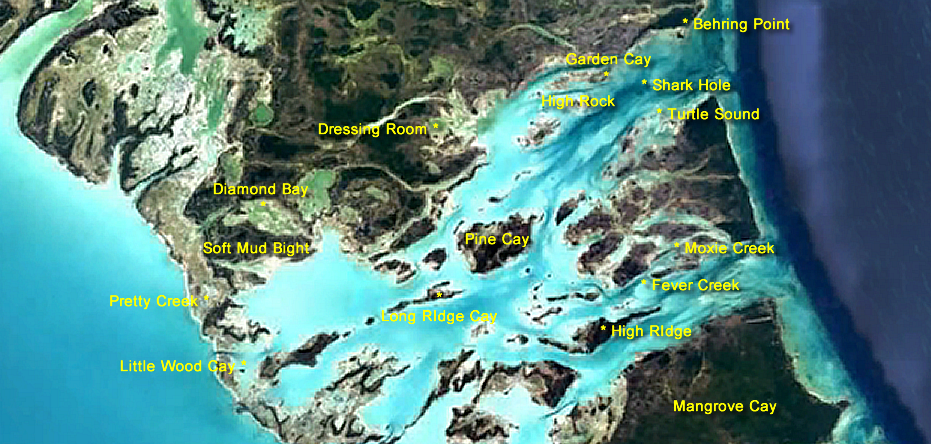
 Easy going, Brad’s typically quiet except for letting you know where he’s keying on sighted fish and how far to cast ‘on the clock’. His poling is remarkable, even in windy, high-wave conditions, easily heading the skiff where you need to be, always mindful of the tide’s condition. Along the huge flats, in large and small bights like Soft Mud Bight, the ‘Dressing Room’, Diamond Bay, and the Pretty Creek area, Brad controls the skiff almost silently, making sure you’re set up for your best cast.
Sighting fish is key to success on the flats, and Brad can pick out the ‘grey ghosts’ in all but complete cloud cover and very, very low light, when it’s tough for any guide. Once seeing bonefish, he’ll help your home in on your prey, and monitor your cast length and accuracy.
Once your fly is close, he’ll quietly suggest stripping actions ’til you hear “He’s on it!” or “You’re right among ’em,” letting you know it’s time for a long strip and a “FISH ON!” yell.
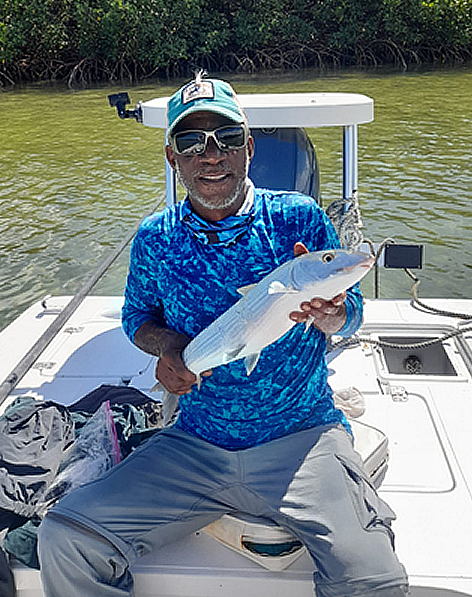
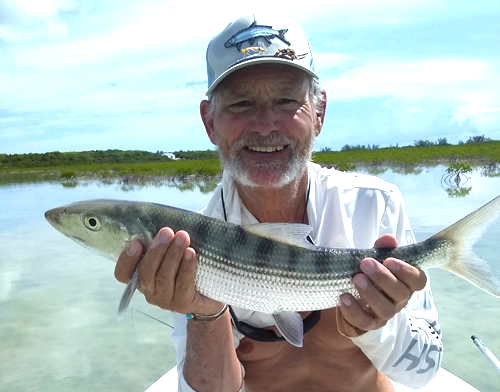
Next, he offers hints on how to play your fish and a helpful landing technique or two to bring the bone to hand. Since most anglers want pictures, you and Brad can work together to capture the image of your success. Keep the fish in the water until you’re ready to snap. A tip: to make sure the fish will survive your photo op, hold your own breath once the fish is out of the water; if you’re ready for a breath, so is the fish, so get it back in the water. A careful fly removal and quick release to the water follow, making sure the quarry is well enough to swim away.
Wade fishing is another experience Brad will help you with: checking the bottom’s density to make sure you won’t be up to your knees in mud, making sure you use a ‘sliding step’ to navigate the area, then pointing out the passing schools, groups, or singles waiting for your cast.
Throw in expert fly selection, a couple of casting tips, and some easy praise for your successes, and you’ll know you’re having a great time on the water with one of the most seasoned guides around.
What to expect on your angling days
- You should be ready to go by 7:30am or so, then walk across the road to the dock, greet your guide, and get your gear and rods settled in the boat.
- You’ll head out for the open water, your guide occasionally checking the water and weather conditions, silently picking the best spot to start.
- After a morning’s scouting and hopefully catching, you’ll typically be taken to a shady spot in the lee of some mangroves for lunch and recap of the early hours fishing.
- On through the afternoon, you may be poled or motored to new spots or entirely new areas, always checking for fish on the way and once you’re set up in a likely flat or small bight.
- Around 4:00pm or so, your skiff will head back to the dock, talking about your hits or misses on the way.
What we expect of you
- Practice your casting frequently: Sure, long casts (50- to 60-foot) are necessary occasionally, but accurate 30- to 40-footers are a must for most situations. Work on your back-cast, too: Not all fish turn up at 25 feet and 10 on the clock. Fish sneak up behind or circle around to the right 0r left side of the skiff, and you want to be ready to handle those 3- or 5-o’clock shots without snagging the guide. Paraphrasing the airlines, “the closest bonefish may be behind you.”
- As for rods, most of our guests bring an 8-weight for general casting and a 9-weight for windy days. Reels should have plenty of backing (175 to 300 yards) so you can enjoy a fish’s long runs without worry.
- Leaders are a personal choice: Extruded or hand-tied sectionals both work well. Tippet size should be 20- or 25-pound strength to keep fish clear of mangrove roots and to bring them in quickly when sharks are around.
- Fly selections can be as simple as four flies of a few patterns or as complicated as a couple of boxes full of a variety of patterns. Good basic bonefish flies include Gotchas, Mantis Shrimp, Squimp, Christmas Island Special, Crazy Charlies, and other similar bonefish patterns sizes 4-6. Tan, crystal, white, pink, orange, and chartreuse are popular colors. You also want differing weights for different water depths.
- Wading boots or shoes help handle varying bottoms, while a pair of very lite-weight socks keep your feet from burning when you’re on the deck while letting you feel the line if it’s underfoot. Long pant/shorts combos worn long keep the Doctor flies and skeeters at bay and, when worn short keep you cool on very sunny, hot days. Shirt types are so numerous, we’ll leave those choices to you, right along with headgear. Polarized sunglasses can be high-end like Smiths, Costas, Bajio Vegas, and Oakleys or as simple as WalMart cheapies – again, up to you. A couple lens colors should cover sunny and cloudy days.
- Sunblock (body and lips) and DEET-based fly dope are recommended. Add in a diphenhydramine cream like Benadryl or a generic equivalent to spread on new itchy bites before they distract you from your fishing.
Andros Middle Bight
Check out the various places you can go, though the choice is always up to your guide’s expertise . . .